
I first started exploring experiential learning in 2005 when I began my Master of Education degree in Leadership and Administration through Gonzaga University. As I reflected on the most powerful learning that I had experienced and the most effective student learning examples I could recall from my time as a high school teacher in British Columbia and Alberta, I continually came back to not the formal lessons, but the extra curricular experiences, field trips and real life projects that the students took part in. When did the lessons of 20th century Europe and the holocaust really hit home for students? Not until we took them to Germany and they were walking through Dachau Concentration Camp and saw what they had been learning about in class. When did I see the importance of student mental awareness, resilience and self reliance come through? Not until we had a medical emergency on an outdoor education trip on the Berg Lake Trail.
I chose experiential education as the focus for my masters thesis project. Much of my research kept pointing me back to John Dewey’s book Experience and Education written back in 1938 and the work of David Kolb (1984) Experiential Learning: Experience as the Source of Learning and Development, with his Experiential Learning Theory model the Kolb Cycle. This started to formalize my use of experiential education in my practice and life through purposeful organized reflection and experimentation.

I started revisiting my masters work in 2011 while working as a Vice Principal at Lake Trail Middle School (grades 7-9) in Courtenay, BC. The school had a great extra-curricular and co-curricular culture that provided students with a real sense of belonging. Unfortunately this sense of belonging and engagement didn’t transfer to the classroom. As a staff we began looking for ways to engage students. Taking the Appreciative Inquiry lens, based on the work of Gervaise Bushe, we tried to look at what was working well outside of the classroom in order to transfer it into the classroom setting. This fit well with my personal philosophical framework on education and sent me back down the road I had started with my masters studies. Working with some fabulous educators and with exceptional teacher leadership from Avi Luxenburg (@aluxenburg, luxenburg.ca), we embarked on a journey to explore inquiry and project based learning in order to engage our students. One of the starting points was Dennis Litkey’s book Big Picture Learning (http://www.bigpicture.org) We gave a copy to all of the teaching staff and used it to guide our staff through what it could look like as a school wide initiative. We used school based Professional Learning Community time help accomplish this.
We also were working as a district with John Abbott (of the 21st Century Learning Initiative) and used the short animations created through the Born to Learn website and his book Over Schooled but Under Educated as a starting point for staff, students, and parents. Our Superintendent at the time, Sherry Elwood (current Superintendent of SD38 Richmond), was a huge supporter of the initiative and of trying to both engage kids and deepen their learning. She not only supported us by doing things like making sure we had access to resources, but gave us permission to try something new. In fact, at one point the entire district leadership team was told that we needed to be trying to do something new. She also had the vision to create a 21st Century Learning committee originally made up of many of the vice-principals in the district at the time: Kyle Timms (Twitter:@k_timms, theoutsidewave.blogspot.ca), Gerald Fussell (twitter:@gfussell, whynot-gfussell.blogspot.ca), Murray McRae and Lyneita Swanson.
We also spent a lot of time looking at the Project Based Learning (PBL) materials produced by the Buck Institute. With special interest in the structures, rubrics and other PBL resources they had developed around PBL.
Eventually, together with a committee including Lake Trail teachers Avi Luxenburg, Ann Marie Kraft and Geoff Williams we began building a school timetable that could reflect the things we believed students needed to be more engaged.
Our focus was
1)to give them less teachers but a greater relationship with each teacher
2)Based on the research of:
Daniel Pink and Drive: The Surprising Truth About What Motivates Us
Mihaly Csikszentmihayli and Flow: The Psychology of Optimal Experience
Give students more choice in their learning
3)We also believed to truly engage students we needed to create a time where they could be totally in charge of their learning through individualized inquiry to create their own learning experience
We ended up creating a podding system, dedicated Inquiry time, and exploratory time; which I wrote about in the article Making Education Meaningful: Inquiry Time at Lake Trail Middle School for the Winter 2013-2014 publication of the Canadian Association of School System Administrators’ Leaders and Learners Magazine.
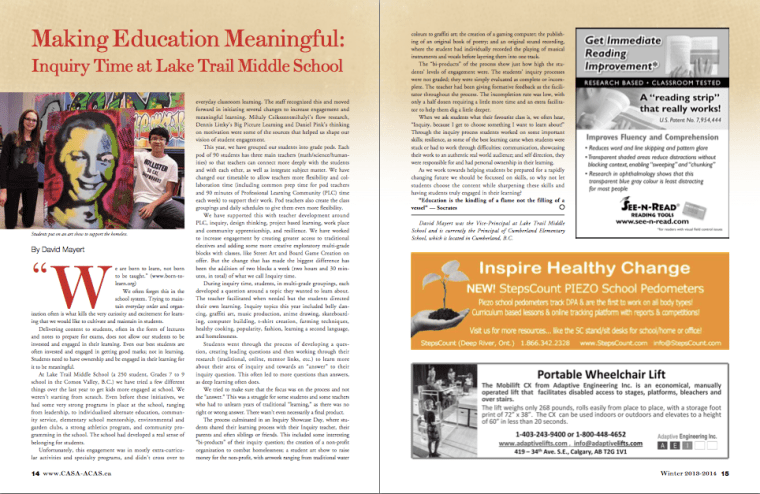
One of the things that helped make the inquiry blocks work were the use of Inquiry integration teachers. These teachers were not assigned students, instead our Arts specialist and Industrial Education specialist teachers were used as experts that could be accessed by all students and teachers to help out with inquiry questions and projects.
Useful Documents we created around our inquiry class and the new timetable included:
Our presentation to parents introducing the changes (Created by Avi Luxenburg):
We had been experimenting with these concepts in our Behavior or PRIDE (Personal Responsibility in Developing Excellence) Program, and found it worked with many of the hardest to reach of our students. We had a student teacher by the name of Dave Randall who had a wealth of life experience and showed a unique ability to reach students and design individualized projects. We loosely modeled the PRIDE Program on the Big Picture model. We also used an online assessment tool called Engrade in order to get parents more involved and track student assignment completion and progress.
We used Ken Robinson’s changing Educational Paradigms to make the concepts behind this change accessible to students and staff.
Parts of this work continues at Lake Trail School five years later under the leadership of principal Gerald Fussell (@gfussell, Why Not?) and with many of the same teachers originally involved.
In support of our work and to expand its’ reach, a group of administrators from School District 71 Comox Valley went to the Big Picture Learning Principals Conference in Los Angeles in February 2013. At this conference we found that many of the things were doing were head of the curve, mostly because the advantages of our British Columbia Provincial Education system compared to that of the states represented at the conference. As we looked to bring some of the changes we were looking at to scale, we found that the Big Picture schools were an example of hard working, engaged educators trying to find a way around the public school system. Because we weren’t fighting the system in the same way, there were few lessons to be learned on bringing the change in our pockets of innovation to scale. The conference was valuable in confirming we were on the right path with many of the things we were doing rather than being transformative. However, this conference was the first time I was exposed to the Design Thinking Process for Education and the work that had come out of Stanford Design School. The sessions by Andrew Frishman (@AndrewFrishman) and Eunice Mitchell (@CoCoaCrazed) about Design Thinking in Big Picture Schools introduced another effective, yet simple framework to put around inquiry, Project Based Learning or Problem Based Learning time.
At the same time, in my personal educational reading, I was drawn to the work of Will Richardson (@willrich45) and his work around his books Why School and From Master Teacher to Master Learner. His thoughts around creating your own meaningful inquiry learning and the inability to do so within the current system resonated with me. The redefinition of the role of teacher was central to the change needed within the system. The blogs of Chris Kennedy, Superintendent of SD45 West Vancouver (@chrkennedy, cultureofyes)and George Couros (@gcouros, The Principal of Change) also helped shape my thinking during this time. Check out George’s recent book The Innovator’s Mindset:Empower Learning, Unleash Talent, and Lead a Culture of Creativity
Further trips to Thomas Haney Secondary School in Maple Ridge showed other ways to change the traditional model of education within our system, by giving students more choice in the timing of their learning and flexibility within a system. But this, too me, still was not the answer we were looking for.
In response to this, the principal of Lake Trail Middle School of the time, Dean Patterson, teachers Grant Taylor, Ann Marie Kraft and I started looking to build a grade 10 program at Lake Trail that would give students a path to follow their passions and use inquiry and Project Based Learning to guide their educational experience. They named it the WISE Program. The WISE program ran for one year as a pilot at Lake Trail before the funding was moved back to the traditional destination school for grade 10 students, Georges P. Vanier Secondary School.
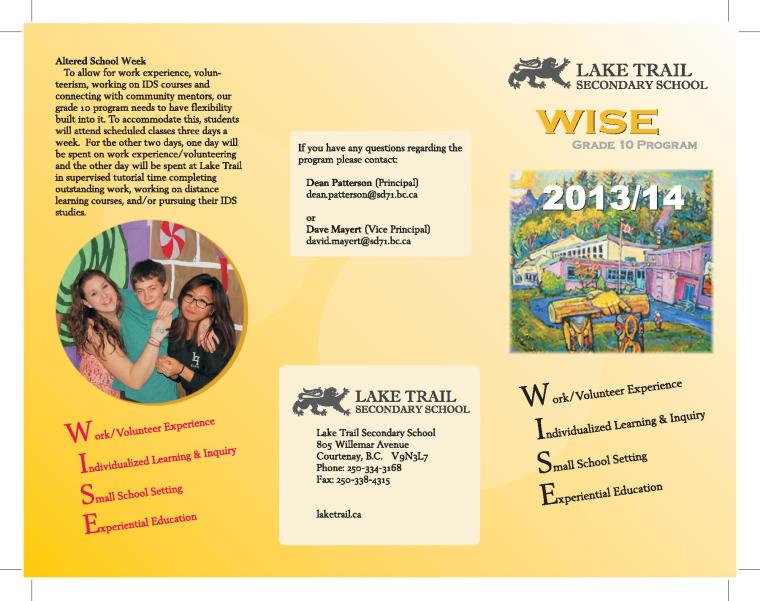
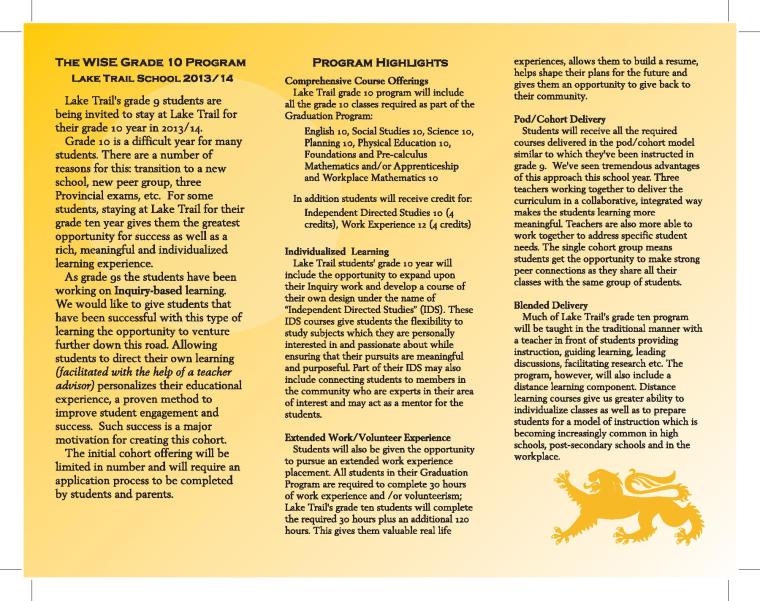
Grade 10 WISE Program Powerpoint
At the same time we were working as part of a Professional Learning Community Committee to bring PLC to scale in SD71. A group of principals including Kevin Reimer (@bcpvpapresident, @Optimus_Rime), Murray McRae, Kyle Timms, Gerald Fussell, Lynette Swanson, Geoff Manning and myself looked at how to facilitate a teacher lead process to bring the PLCs that existed in some schools to all in the district. As part of this we took part in the Solution Tree PLC at work conference in April of 2013 in Vancouver. It had been ten years since I had last been to a DuFour PLC conference, the first having been in Edmonton in 2004. I had the experience of working as a teacher during the implementation of a Professional Learning Community framework at the Grande Prairie Composite High School back in 2004. At the Vancouver Conference I was able to reconnect with many former colleagues from the Grande Prairie Composite High, including the former Principal, Rick Gilson (@rgilson1258, rickgilson.ca). I had the privilege to have worked closely with Rick not only as a teacher, but as a coach of the Comp Warriors Football Program under his leadership as head coach. We leveraged this relationship and the connection with our Secretary Treasurer and former Grande Prairie Associate Superintendent of Business Services, Russell Horswill, to have Rick Skype into one of our initial district wide conversations on bringing PLC to scale in Comox Valley. His first hand account of not only the good that had come from their work, but about potential pitfalls, helped us navigate what was a quite ambitious implementation as the first public school district in BC to have district wide PLCs. The district also brought in Neil Smith, PhD. and Sean McKierahan, MEd, to run a summer institute and help lead to implementation. Leah Taylor was brought on board as researcher and coach for the project. We used the book Professional Learning Communities at Work: Best Practices For Enhancing Student Achievement as a reference guide around the district. PLC time district wide gave us an opportunity to take the innovation that was happening in pockets around the district to scale.


In the spring of 2013 I had the opportunity to apply for a Principal position in the Comox Valley. It was a tough choice to leave Lake Trail Middle School, as many of us felt we were part of something special at the time, but I was ready for a new challenge. As part of the application process I was asked to create a presentation outlining how I saw my role in:
My time at Lake Trail had been a time of great growth as an educator and educational leader, and had given me the opportunity to work alongside some excellent teachers. I was fortunately successful in the competition for the principal position and was grateful for the opportunity to put my learning into practice in my new role as Co-Principal at the newly created Cumberland Community School.
 It's About the Ride