The other day I was lucky enough to join our Cumberland Community School Nature Grade 1 class as they spent their morning learning along the trails in the Cumberland Community Forest. Seeing these students flourish in an environment of nature based, play based and place-based learning, where they are connected to nature, once again validated all the hard work we have put into creating this program.
We have been working at Cumberland Community School (CCS) over the last 3 years to focus on outdoor and nature-based education. From 2013-2015 the school engaged our partner groups (including students, teachers, parents and community members) to develop a vision for Cumberland Community School.  CCS Visioning Document 2015.pdf Through the process we identified a demand for nature-based education that echoed through our visioning themes.
In the fall of 2014 we began exploring the idea of a Nature Kindergarten Program at CCS. We researched many existing programs such as the Sooke Nature Kindergarten in Victoria, the Cedarsong Forest Kindergarten in Washington State, and worked closely with local Cumberland Nature Preschool operator Erin McNamara who trained at Cedarsong and had taught with Lisa Lockerbie of the Sooke Nature Kindergarten.
We looked at literature including:
At the same time we met with potential parents of students on several occasions to get their feedback on possible structures. With the annual kindergarten registration we put out a statement of intent for parents wishing for their children to take part in the program for kindergarten. At the same time we put out the same statement of intent for a potential grade 1 program, as we thought we might have to run a Kindergarten/Grade 1 split class in order to get the numbers needed. We quickly received enough interest in kindergarten to make the program a reality without including the grade 1s. The interest and demand were a direct result of the nature preschool programs operating in the valley, including Jarett Krentzel’s Hand in Hand Early – Years Nature Education Program and the momentum initiated by Erin McNamara’s Little Squirrel’s Burrow.
For the 2015/2016 school year we were able to offer a Nature Kindergarten program for CCS students whose parents wanted to see their kids have a nature based option. This included the students spending every morning outside rain or shine. The students and parents quickly adopted the popular outdoor mantra, “there is no poor weather, just poor clothing”. Students each had rain pants, coats, boots, hats and mitts/gloves to protect them from the elements. Each student also carried an adventure pack containing: a snack, water, band-aids, tissue, a whistle, extra clothing (layers), and a laminated card with their name and the school’s phone #. Volunteers also had packs containing a map of the route and meeting spots, the school contact numbers and class lists.
We were lucky to have Erin McNamara as the teacher for this initial cohort. Her experience and skill set went a long ways towards making this program a success. Before the start of the school year she participated in the Annual Kindergarten and Primary Institute at the
University of Victoria, which just happened to be focusing on learning in nature with facilitators including Lisa Lockerbie and Pamela Quigg.
Unlike the program in Sooke, we ran our program without an Early Childhood Educator and instead relied on parents to volunteer in the morning during “forest time”on a regular basis and help supervise on field trips. Outside time started with forest time on campus, but by October the students spent two of their mornings in the
Cumberland Community Forest, a fifteen minute walk off campus. The students also claimed a forested area on campus as their classroom. They cleaned up the garbage in the area, mapped it, built trails, and cleared out a meeting spot. They took real ownership of the area, putting up signage naming it “Imagination Thicket” and asked visitors not to litter. They were very much empowered and connected to this place in nature.
There were many things to celebrate from our first year of Nature Kindergarten at CCS. One of the biggest things we noticed was the wonderful community that developed in the classroom. This also extended to the parents, as their high level of engagement resulted in a strong parent community. Parents got to really know their child’s teacher, which helped them quickly trust Erin with their young child, which is an extremely important part of the early days of Kindergarten. Parents also got a chance to see their child as a learner, build relationships with other students and share their expertise and knowledge with the class.
We observed the students both exhibiting increased self-regulation and mindfulness as the year progressed. While there were a lot of physical, emotional and cognitive benefits to the program, the students probably benefited most from their high levels of engagement. This was due to the fact that the learning was so hands on. It was real and mattered to them!
In the spring Erin and fellow SD71 teacher Briar Pateman, attended a two-day workshop entitled “
Making Authentic Inquiry Work” facilitated by the
Natural Curiosity research group at the University of Toronto. This brought in another focus for the program, environmental inquiry.
The response to the Nature Kindergarten program was very positive and as a result of our success and parent interest we decided to expand our offerings to include both a Nature Kindergarten and Nature Grade 1 cohort for the 2016-2017 school year.
Briar Pateman has expertly taken on the challenge of the grade 1 group, picking up where Erin McNamara left off last year, and continuing to build a wonderful classroom community and expanding the focus on the Aboriginal Principles of Learning.
When I met up with the class a few mornings ago, I followed my copy of the map I had been given (the same one students studied prior to leaving the school) to one of their designated learning routes, and found them in a beautiful, forested learning environment designated by orange cones as safe boundaries. They were just finishing up their leave no trace snacks and being reminded to be good environmental stewards. The students were then divided up into small groups to work on different learning activities.
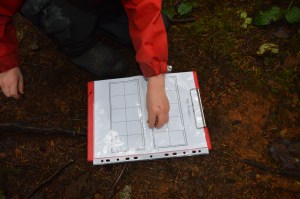
One group, under the direction of Ms. Briar, was learning numeracy through dice games, using natural objects and ten frames.
Another group was given a colour sight word activity that a parent volunteer helped facilitate. Students made as many connections in nature as they could to the colours that were presented. This went beyond the simple connections of green and brown and made the students dig a little deeper. A third group worked with a parent volunteer and First Nations animal puppets to be creative and become their animal describing the animals activities and traits in nature.
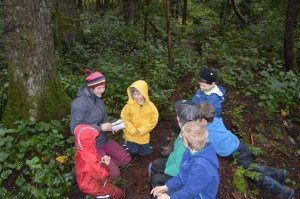
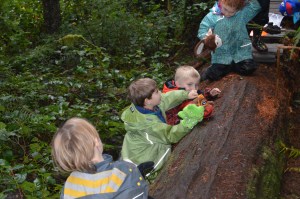
After this activity the students moved to their “sit spots” or “Perch of Perception”. They return to the same spot in the woods on a regular basis to be observant and mindful of the changes in their surroundings through several minutes of silence and observation. Students were reminded of the 7 S’s to describe their time at their perch: sit, solo, silent, safe, scientific, still, same. During this time students were invited to quietly create in their sit spot. Several students proudly earned a pink “creative” bead to go on their jacket. Other students eagerly showed the yellow beads they had earned previously for showing compassion. The colours represented the
successful learner traits that are being introduced to students. The traits come from the work of SD71 teacher Sue Bannister.
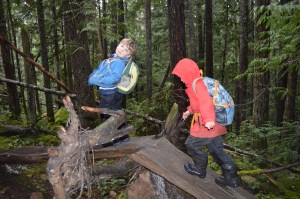
After taking the time to be mindful in their Perch of Perception, we were back on the trail. Students were partnered up with their assigned buddy and counted for safety purposes, and were then led down the path by Ms. Briar, with parent volunteers in the middle of the group and bringing up the rear. During this movement time there was a real focus on making safe choices and taking controlled risks while walking through the biking/hiking paths over obstacles, across logs and jumping down drops. The students all pressed their “control” buttons before going down the hills and over the obstacles, but were encouraged to move out of their comfort zones by remembering “challenge by choice.”
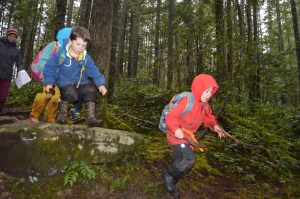
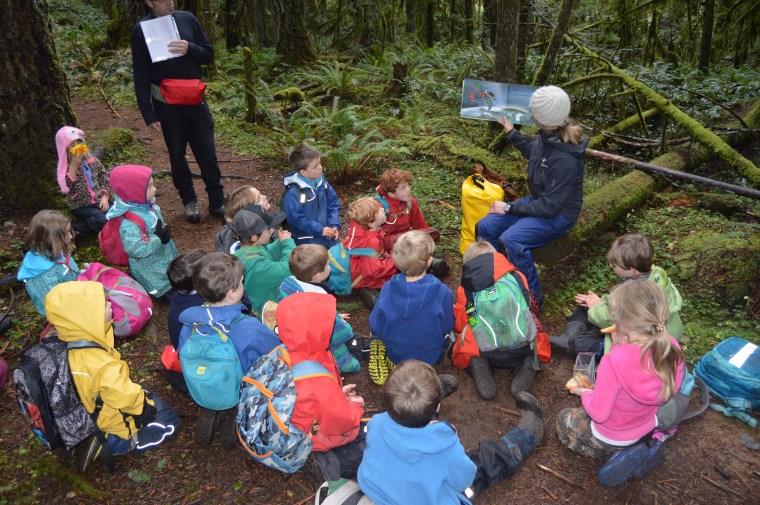
Next up, was a stop for another safety count and a book break. The story time was not only an example of using literacy in nature, but of incorporating First Nations content. Raven: A Trickster Tale from the Pacific Northwest, told the legend of how the Raven stole the sun from the Sky chief and gave it to the people. The class made comparisons and connections to the other Raven legends they have read as a class, and have as a book choice. As the class is focused on a “sky inquiry”, it encouraged students to think about the sun and cycles of day and night. There was also evidence of protocols of respect with the Aboriginal talking circles that have been incorporated into the class.
We were then off on the trail again. Before leaving the forest we played a game of
Eagle Eye, and then walked back up to the school for lunch.
It was great to see the evolution of this program and how the students are being challenged. The constant movement through the trails combined with stops for focused learning activities and games was extremely effective with the group of students. The physical activity helped them focus at the appropriate times. Seeing the students encouraged to take calculated risks while they navigated the trails was fantastic. We need to teach our students to be risk takers, but self-mitigate that risk by being calculated risk takers. I was further encouraged by the Perch of Perception and the use of mindfulness in nature (22 five and six-year olds sitting quietly for ten minutes is impressive in its’ own right) and the incorporation of numeracy, literacy, and the arts in a manner that complemented the outdoor learning. You could tell the students were thoroughly engaged by the combination of play-based, place-based and nature-based learning.
My adventure with this group further cemented the need to incorporate more nature-based learning throughout a child’s schooling, not just at the early years but, throughout their K-12 school career. Our nature based programs require a special educator and are beyond the comfort level of many teachers, but elements of the program could and should be incorporated into every classroom.
I look forward to more adventures with our nature Kindergarten and Grade 1 classes this year and learning with our Nature Grade 2’s next school year as our CCS Nature program grows!
 It's About the Ride
This sounds so fantastic Dave! I think getting outside is so important for kids. If you’re ever interested in having me come to your school, as part of my job I deliver nutrition workshops to teachers. One of them in particular is a 6 lesson plan that revolves around planning an outdoor excursion while also planning healthy eating. Let me know if you’re interested and I can send you more info. Here’s the link to the program I’m referring to: https://bcdairy.ca/nutritioneducation/workshops/passport-to-healthy-living-passeport-pour-une-vie-saine-grades-4-7
LikeLike
Thanks Nicole! I have forwarded on the link to the program to several of our teachers and hopefully we can get enough interest to put on a workshop!
LikeLike
Hi Nicole! We have a group of teachers that would really like to take the Passport to Healthy Living Workshop. this spring. When can we make it happen?
LikeLike
Yikes, so sorry Dave, I didn’t check the box to receive notifications for replies (accidentally) so I missed all this thread and just happened to be checking back now (Mar 21st)! To book the workshop, they can email me at nspencer@bcdairy.ca. We come to you at the time that works for you. Thanks so much for sharing about our workshops 🙂
LikeLike